AI Roadmaps: Why Most Companies Are Building the Wrong Things
Many companies are rushing to add AI to their roadmaps, but competitor pressure and technology hype often lead them to build impressive capabilities that customers neither need nor value enough to use.
Written by
Saurabh Chaudhari
Read time
7-8 mins read
Posted on
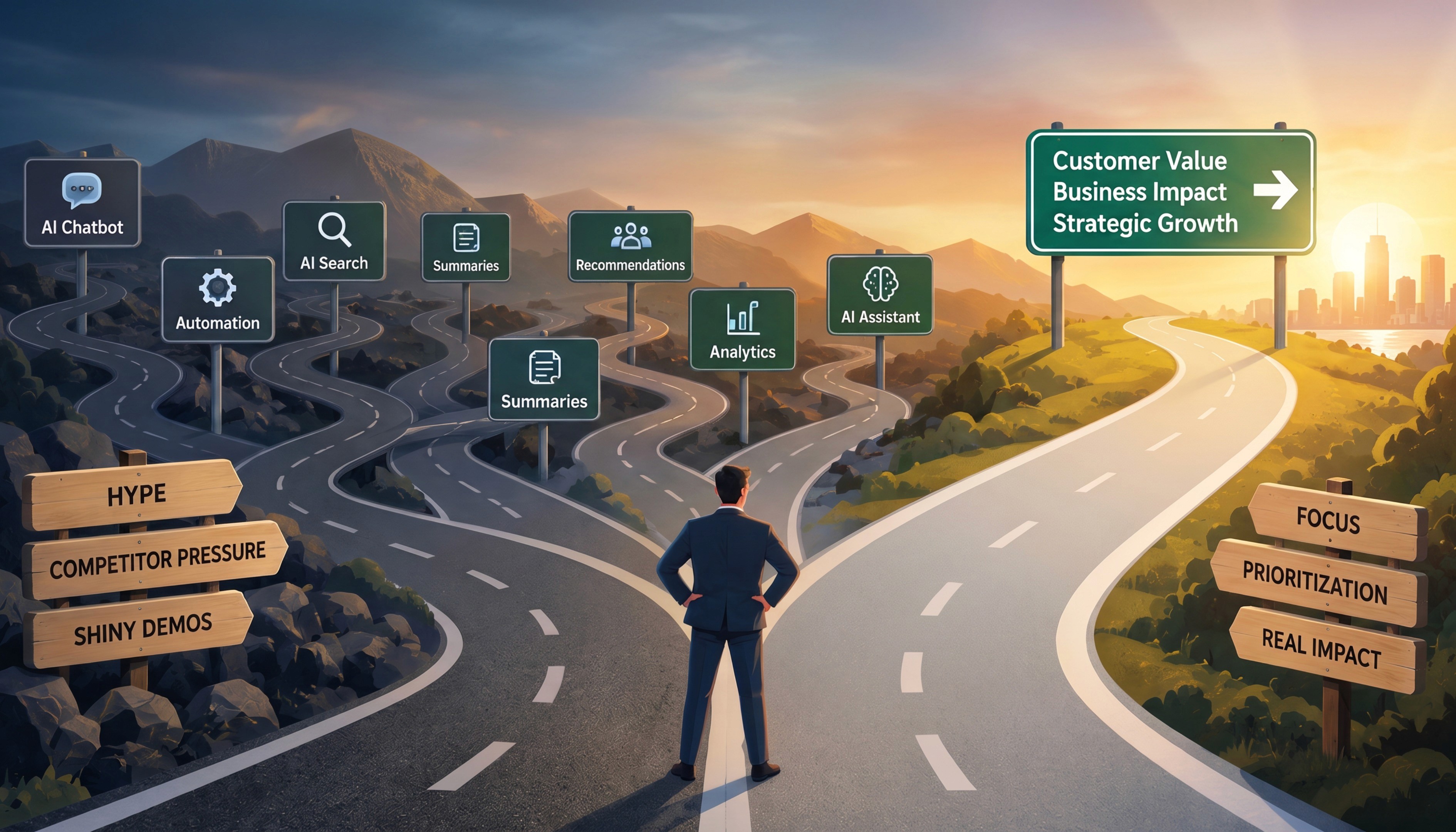
The AI Roadmap Has Become a Checklist
Look at enough product roadmaps today, and you'll start seeing the same things:
AI chatbot
AI assistant
AI search
AI recommendations
AI summaries
AI automation
Different companies.
Different industries.
Remarkably similar roadmaps.
Why?
Because many companies aren't starting with:
"What problem should we solve?"
They're starting with:
"What AI capabilities should we have?"
And that is where the roadmap starts going wrong.
The Pressure to Have an AI Story
There is enormous pressure on leadership teams to demonstrate an AI strategy.
Customers ask:
"What are you doing with AI?"
Investors ask:
"How is AI changing your business?"
Competitors announce:
"We just launched AI-powered capabilities."
Suddenly, the roadmap needs an answer.
So teams start adding AI initiatives.
Not necessarily because customers need them.
But because not having AI on the roadmap feels risky.
This creates a dangerous pattern:
Fear drives the roadmap instead of strategy.
The Problem Isn't Building AI
The problem is building the wrong AI.
Companies can spend months developing:
Sophisticated assistants
Advanced automation
Intelligent recommendations
AI-powered analytics
And still see:
Low adoption
No measurable revenue impact
Increased operating costs
More product complexity
The technology may work perfectly.
The product decision may still be wrong.
Why Companies Build the Wrong Things
1. They Start with Technology
The conversation begins with:
"What can we build with AI?"
That creates an endless list of possibilities.
But possibility is not priority.
A better starting point is:
"Where is the biggest problem in our customer journey or business?"
Only after identifying the problem should you evaluate whether AI is the right solution.
2. They Copy Competitors
A competitor launches an AI assistant.
You add one.
Another competitor introduces AI search.
You add that too.
Before long, your roadmap becomes a reaction to everyone else's announcements.
But competitors operate with different:
Customers
Data
Workflows
Business models
Product strategies
What makes sense for them may make no sense for you.
Competitive awareness is important.
Competitive imitation is not strategy.
3. They Prioritize the Most Visible Ideas
Some AI features are easy to demonstrate.
A chatbot can produce an impressive demo in minutes.
An AI-generated summary looks intelligent immediately.
But highly visible does not mean highly valuable.
Some of the most impactful AI capabilities are less exciting to showcase:
Reducing manual operations
Detecting errors
Improving internal workflows
Identifying risks earlier
Helping teams make faster decisions
The best AI opportunity may not be the best demo.
4. They Confuse Customer Interest with Customer Value
Customers may say:
"AI would be nice to have."
That doesn't necessarily mean:
"I would pay for this."
Or:
"I would use this every day."
There is a significant difference between:
Interesting
Useful
Essential
Many AI features never move beyond the first category.
A roadmap should prioritize problems customers truly care about, not features they are curious to try once.
5. They Don't Consider the Cost of Ownership
Every roadmap item has a development cost.
AI has something more:
An ongoing operating cost.
You need to consider:
Model and API usage
Infrastructure
Data pipelines
Monitoring
AI evaluation
Quality assurance
Continuous improvement
A feature that looks strategically important at planning time may have poor economics at scale.
The roadmap should not ask only:
"Can we build this?"
It should also ask:
"Can we operate this sustainably?"
The Missing Layer in Most AI Roadmaps
Most product roadmaps look something like this:
Idea → Feature → Development → Launch
For AI, that's not enough.
A stronger AI roadmap needs to include:
Problem → Business Value → AI Fit → Risk → Economics → Adoption → Scale
Every layer matters.
Because an AI feature can fail at any one of them.
For example:
Great problem, wrong technology
Great technology, poor economics
Great economics, low adoption
Great adoption, unacceptable risk
Building AI is only one part of the decision.
Start with Problems, Not AI
Instead of creating a section in your roadmap called:
AI Initiatives
Try starting with:
Customer Problems
For each problem, ask:
How painful is it?
Does it create meaningful friction?
How frequently does it occur?
A daily problem may be more valuable than a dramatic annual one.
How many customers experience it?
Is this a niche problem or a widespread opportunity?
What happens if we solve it?
Does it improve:
Revenue?
Retention?
Efficiency?
Customer satisfaction?
Risk?
Only then ask:
"Can AI help solve this better than traditional technology?"
A Better Way to Prioritize AI Initiatives
Not every AI idea deserves the same investment.
I believe every AI initiative should be evaluated across five dimensions.
1. Customer Value
How meaningful is the problem being solved?
Ask:
Does it remove friction?
Does it save significant time?
Does it improve an important decision?
Does it unlock something customers cannot do today?
2. Strategic Differentiation
Will this actually make your product harder to replace?
Or is it simply another feature every competitor can copy?
The strongest opportunities often combine AI with:
Proprietary data
Domain expertise
Unique workflows
Existing product capabilities
3. Business Impact
What business metric could move?
Examples:
Conversion
Retention
Revenue per customer
Cost per operation
Team productivity
If the business impact is unclear, the initiative should not automatically receive priority.
4. AI Readiness
Do you actually have what is required to make this work?
Consider:
Data availability
Data quality
Technical architecture
Integration requirements
Team capability
A high-value idea may still need to wait until the foundation is ready.
5. Risk and Economics
Finally, ask:
What happens when AI is wrong?
How expensive will it be to operate?
How does cost scale with usage?
What level of QA and oversight is required?
An exciting idea with unacceptable risk or poor economics may not belong at the top of the roadmap.
The Roadmap Should Have Different Horizons
Another common mistake is treating every AI initiative as a feature to build immediately.
A better roadmap separates opportunities into horizons.
Now - Proven Opportunities
Problems where:
Customer value is clear
Data is available
AI fit is strong
Business impact is measurable
These are the initiatives worth executing.
Next — Strategic Capabilities
These may require:
Better data
Platform improvements
Architecture changes
More experimentation
They are important—but not yet ready for full investment.
Later — Emerging Bets
These are ideas with potential but uncertainty.
The goal is not to build them immediately.
The goal is to:
Learn
Experiment
Monitor technology
Validate assumptions
Not every good idea needs to become a roadmap commitment today.
The CEO's Role in the AI Roadmap
The CEO doesn't need to decide:
Which model to use
How prompts are structured
Which vector database is selected
But the CEO must ensure the roadmap answers bigger questions:
Are we solving the right problems?
Are these priorities connected to business strategy?
Are we investing in differentiation or imitation?
Do we understand the economics?
What are we deliberately choosing not to build?
The final question is particularly important.
Strategy is not just deciding what to do.
It's deciding what not to do.
What We See Working at Thynqit
At Thynqit, we believe an AI roadmap should not be a collection of AI features.
It should be a sequence of deliberate investments.
We look at AI opportunities through multiple lenses:
The customer problem
The business outcome
The product workflow
The technical readiness
The quality and risk requirements
The long-term economics
Sometimes AI is the right answer.
Sometimes traditional software is better.
And sometimes the idea simply doesn't deserve to be built.
The discipline to make that distinction is what creates a stronger roadmap.
Final Thought
The biggest risk in AI isn't falling behind.
It's spending the next two years building things that don't matter.
The companies that win won't necessarily have:
The longest AI roadmap
The most AI features
The flashiest demos
They'll have something more valuable:
The discipline to identify the right problems—and the courage to ignore everything else.
That's what an AI strategy should look like.